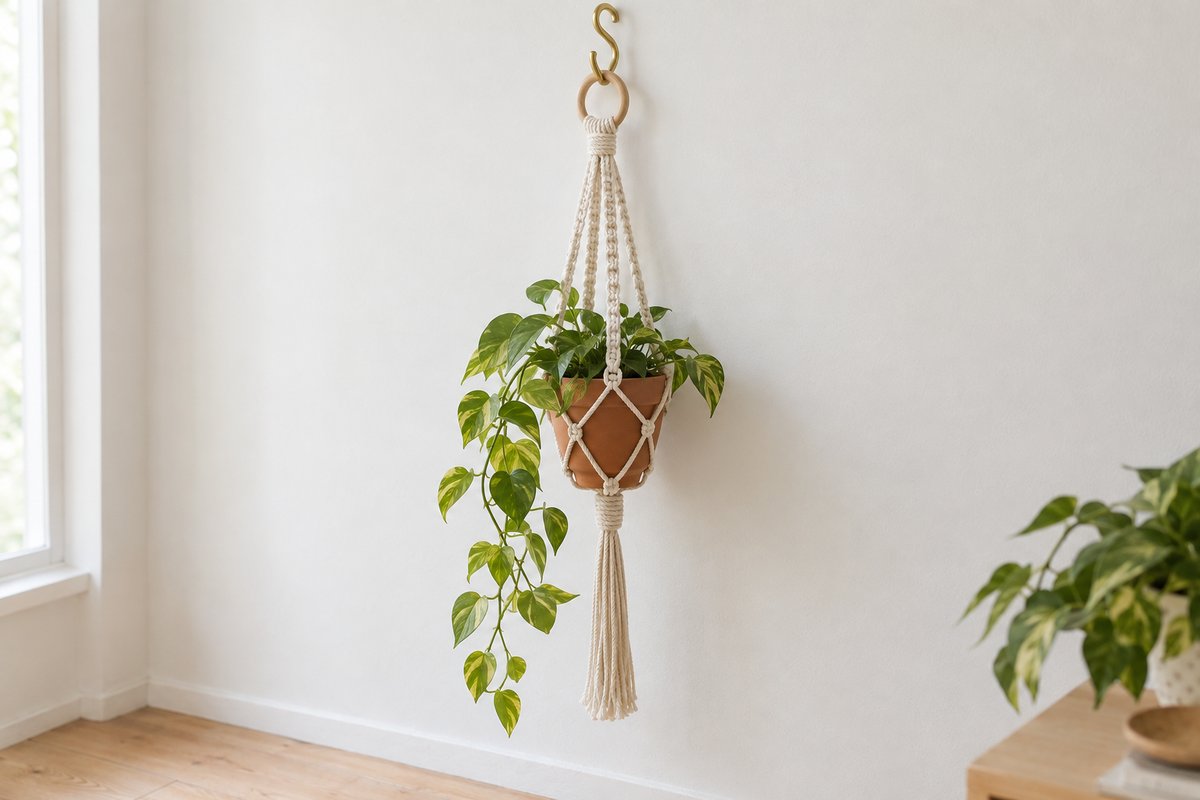
A macramé plant hanger is a knotted cotton sling that lifts a potted plant off the shelf and hangs it at eye level, where a trailing pothos can spill over the edge. This beginner version uses only two knots, the wrapping knot and the square knot, plus a few plain overhand knots in the tassel. It takes about 90 minutes, needs no tools beyond scissors and a tape measure, and costs under $10 in cord. The finished hanger is about 1 m (40 in) long and holds a 6 inch (15 cm) pot.
In this post
What you need
Materials
| Item | Quantity | Notes |
|---|---|---|
| 4 mm cotton macramé cord, single twist or 3-ply | 8 cords x 4 m (13 ft), plus 1 m (40 in) for the wrapping knots; about 33 m (108 ft) total | A 50 m (164 ft) roll is the smallest common size |
| Wooden or metal ring | 1, about 2 in (5 cm) across | Light wood or brass |
| S-hook | 1, 2 to 3 in (5 to 8 cm) | Rated for 10 lb (4.5 kg) |
| Pot with plant | 1, 6 in (15 cm) diameter | Terracotta or ceramic |
Tools
- Sharp fabric scissors
- Tape measure
- An over-door hook, clothes rail or painter’s tape to hang the ring from
- A wide-tooth comb for the tassel (optional)
- A strip of card cut to 7.5 cm (3 in) as a spacing guide (optional)
Approximate cost: a 50 m roll of 4 mm cotton cord is $6 to $9 at craft stores or online, a wooden ring $1 to $2 and an S-hook $1 to $2, so one hanger comes in under $10 with cord left for a second. Single-twist cord gives the fluffiest tassel and is the most forgiving to knot; 3-ply is stronger and untwists into a wavy fringe. Avoid braided cord, which will not comb out, and jute, which sheds.
Before you start
Decide on the finished length first. This hanger measures about 1 m (40 in) from ring to tassel end, right for a hook under an 8 ft (2.4 m) ceiling. The rule of thumb is to cut each cord to about four times the finished length; every cord is folded in half over the ring, so the 4 m cords become sixteen 2 m working strands and the knots and tassel use up the difference. For a longer hanger, more knots, or a pot bigger than 8 in (20 cm), move up to five or six times the finished length. Running out of cord cannot be fixed partway through.
Knots stay even only when the cords hang under their own weight, so hang the ring at eye level with the cords dropping to the floor: an over-door hook, a clothes rail, or painter’s tape folded over the top of a door all work. Allow 10 minutes to cut and set up, 30 for the top knots, 20 for the basket and 10 for the tassel. Nothing is hot or sharp beyond scissors, so it is safe with older children, and it suits a window with a dried orange slice garland.
Macramé plant hanger, step by step
Step 1: Measure and cut the cords
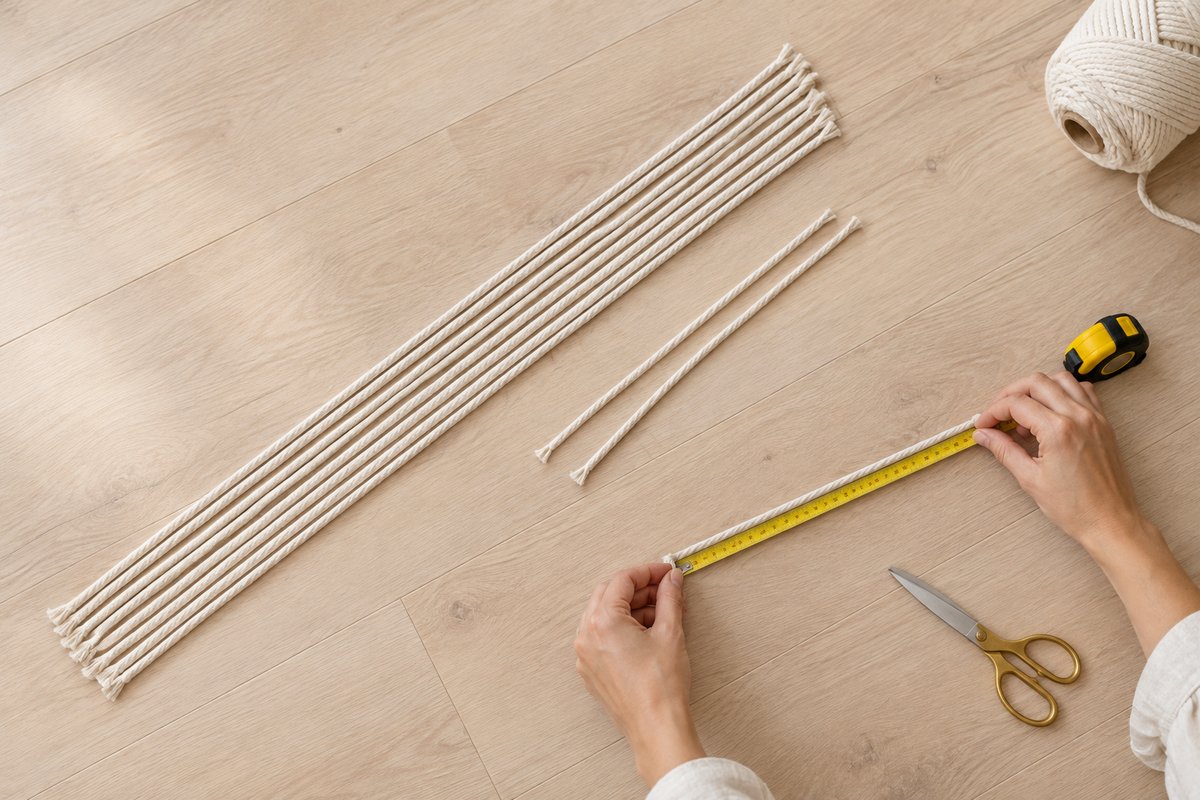
Cut 8 cords, each 4 m (13 ft) long. Without a long tape, put two marks on the floor 2 m (6.5 ft) apart, run the cord back and forth between them and cut at every second turn. Keep the cuts clean and square; a ragged end frays and is harder to thread. Cut one more piece 1 m (40 in) long and halve it for the two wrapping knots. Lay the 8 long cords side by side, line up one end, and fold the bundle in half to find its midpoint.
Step 2: Thread the ring and hang it at eye level
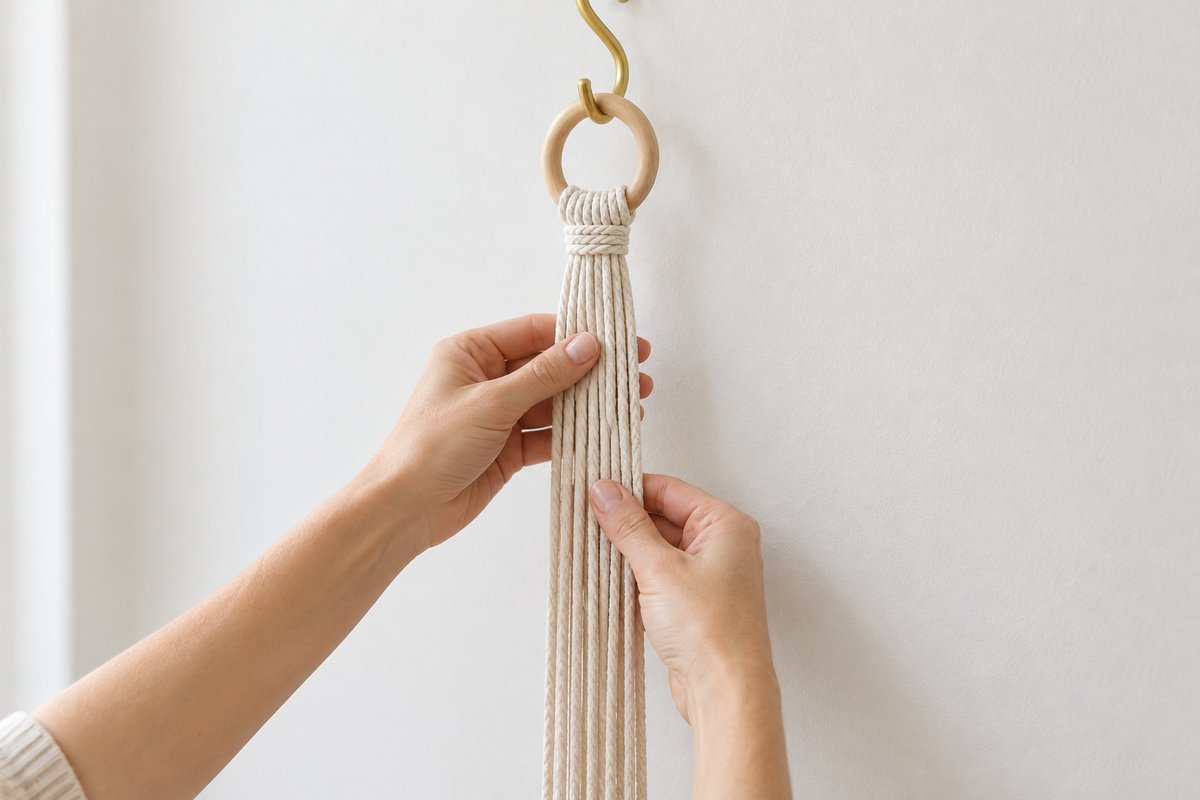
Fold the 8 cords in half so all 16 ends line up. Push the folded loop through the wooden ring, open it, pass the 16 loose ends through that loop, and pull until it closes snugly around the ring. This is a lark’s head knot; the wrapping knot in the next step covers and locks it. Hang the ring on the S-hook on your door hook or rail at eye level with the cords hanging straight to the floor. Shake the bundle out so no cords cross above the ring and all hang the same length.
Step 3: Tie the top wrapping knot
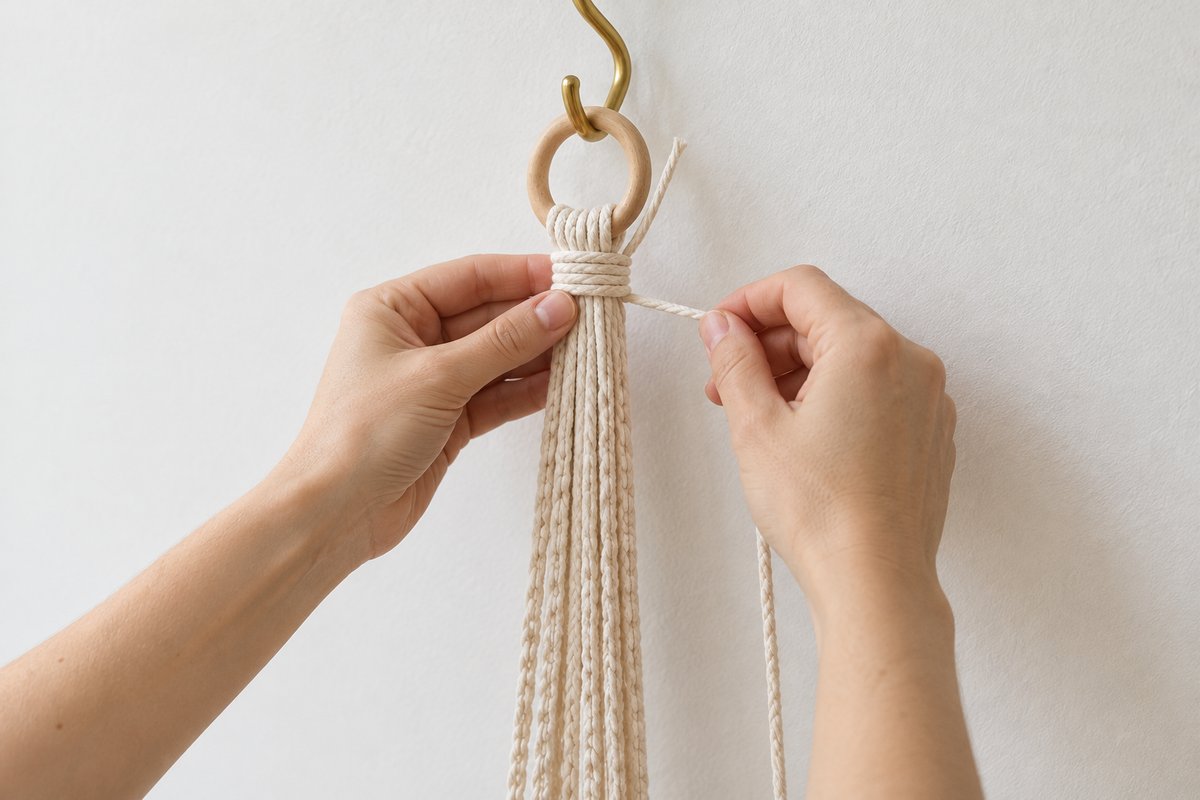
Fold one 50 cm (20 in) piece into a long U shape and lay it against the bundle just below the ring, with the bend pointing down about 4 cm (1.5 in) below the ring and the short tail pointing up past it. Hold the U with your thumb and wrap the long end around the bundle and over the U, starting directly under the ring and working downward. Wrap firmly 8 to 10 times with no gaps. Push the end through the bend, then pull the top tail upward until the bend slides up under the wraps and disappears about halfway in. Trim both tails flush.
Step 4: Divide into four groups and tie the first square knot
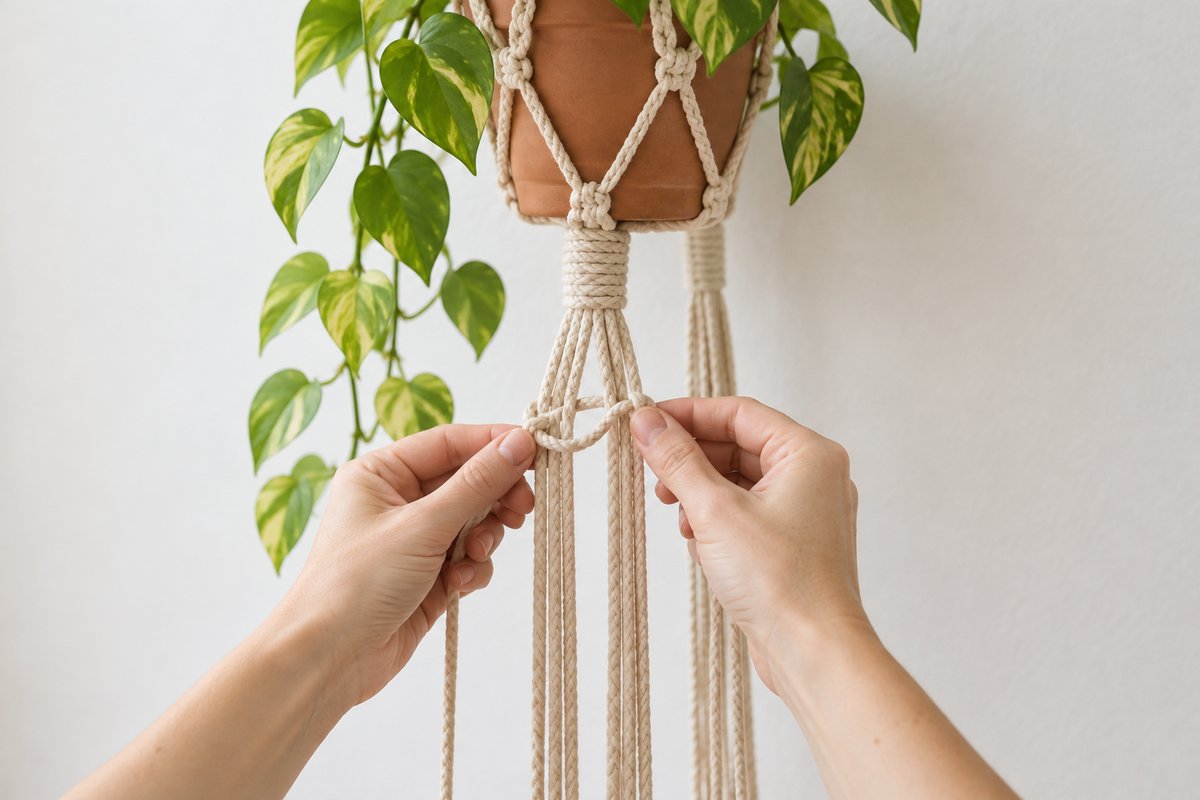
Separate the 16 cords into 4 groups of 4 neighbouring cords. In one group, number the cords 1 to 4 from left to right. Cords 2 and 3 are the fillers and stay straight; cords 1 and 4 do the work. First half: lay cord 1 over cords 2 and 3 and under cord 4, making a shape like the number 4. Take cord 4 behind cords 2 and 3 and up through the loop on the left, over cord 1. Pull both working cords out sideways and snug the half knot up to the wrapping knot. Second half: lay the right working cord over the fillers and under the left one, then take the left cord behind the fillers and up through the loop on the right. Pull snug. That is one left-facing square knot.
Step 5: Build the four square-knot sinnets
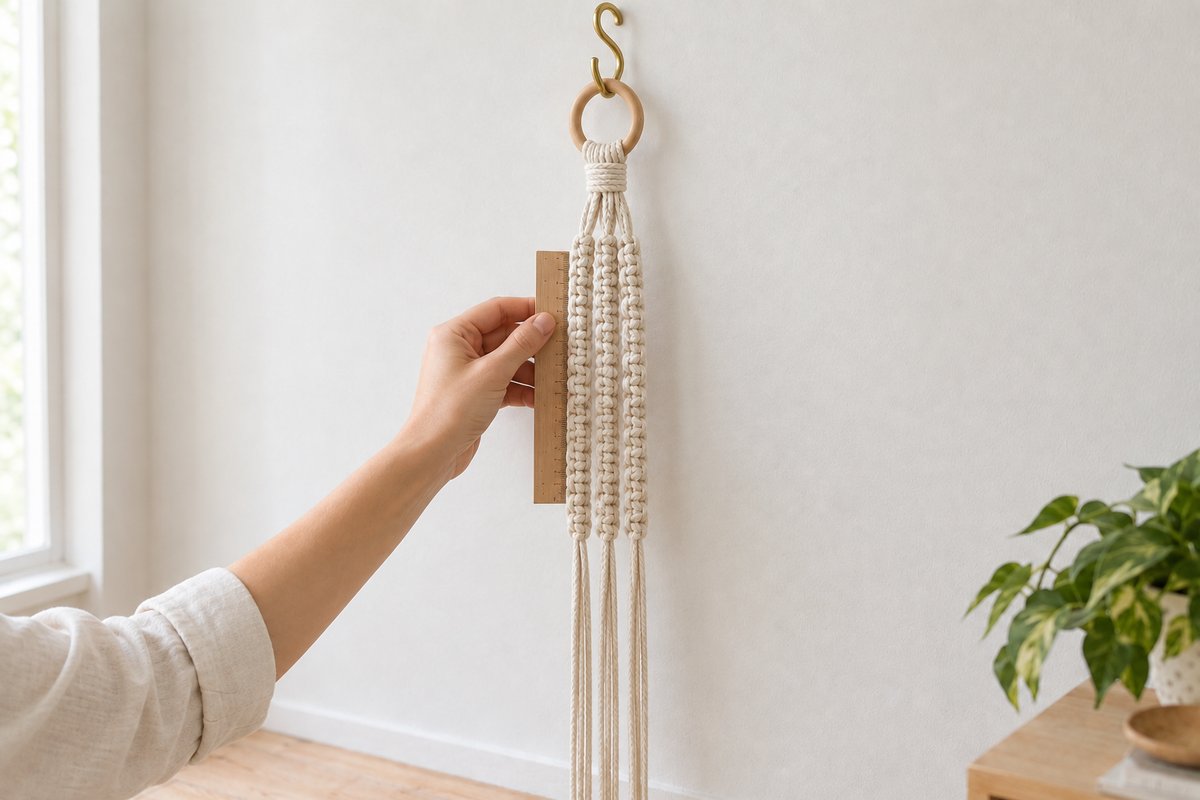
Repeat the full square knot, first half then second half, directly beneath the first until the column (called a sinnet) is 15 cm (6 in) long, about 12 knots in 4 mm cord. Always start with the left cord over the fillers, so every knot faces the same way and the column lies flat. Snug each knot up to the one above with the same firm pull; the goal is even tension, not maximum. Tie an identical sinnet on each of the other three groups, counting knots so all four end at the same height.
Step 6: Tie the first row of basket knots
Measure 15 cm (6 in) down from the bottom of the sinnets and tie one square knot in each group at that height, using the same four cords each group already has. This row marks where the rim of the pot will sit, so hold the pot up inside the four groups before you tighten: the knots should sit just above the rim. Use the card strip twice as a guide and pinch the spot on each group before knotting, because this gap decides whether the basket hangs level.
Step 7: Alternate the cords to form the net
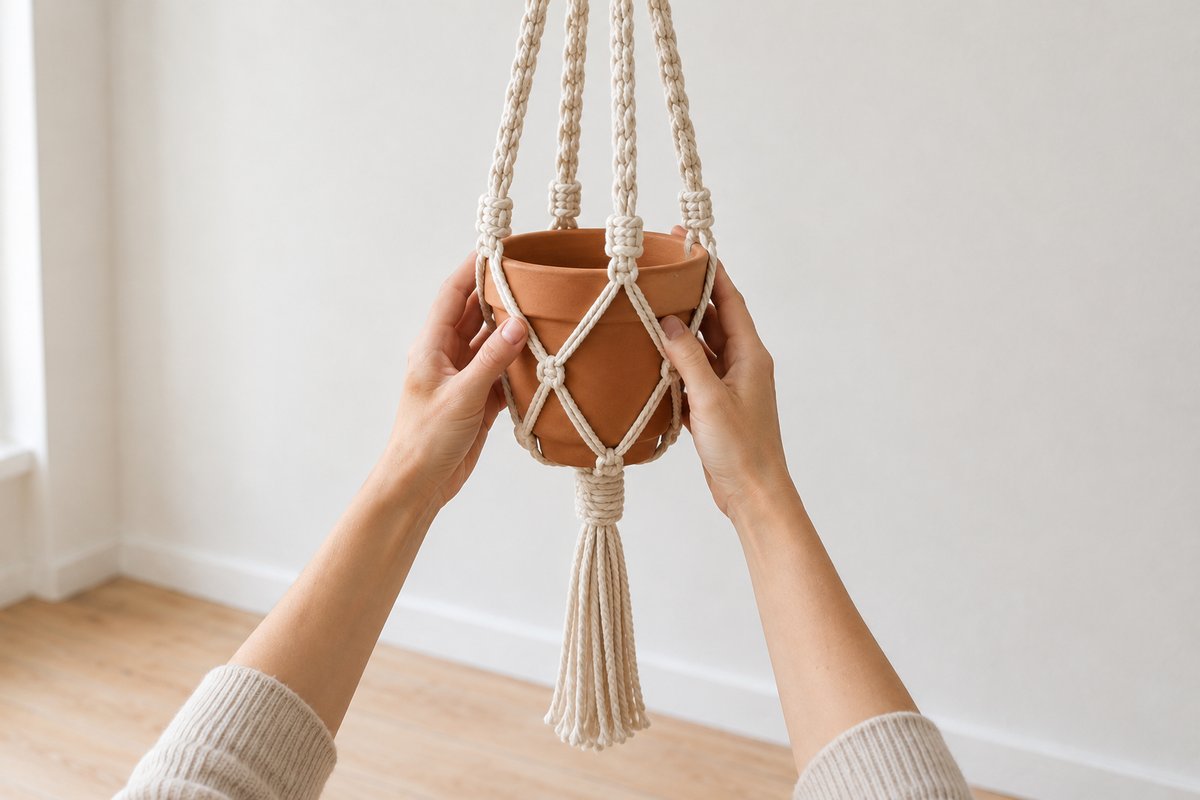
Measure 7.5 cm (3 in) below the first row. Take the 2 right-hand cords of group 1 and the 2 left-hand cords of group 2 and tie a square knot with these 4 cords, the outer two working around the inner two. Do the same between groups 2 and 3, groups 3 and 4, and finally group 4 and group 1, closing the net into a tube. Measure a further 7.5 cm (3 in) down and tie a third row, swapping cords again so each knot sits between the two above it. The three rows form a diamond net that cradles the pot with a little slack.
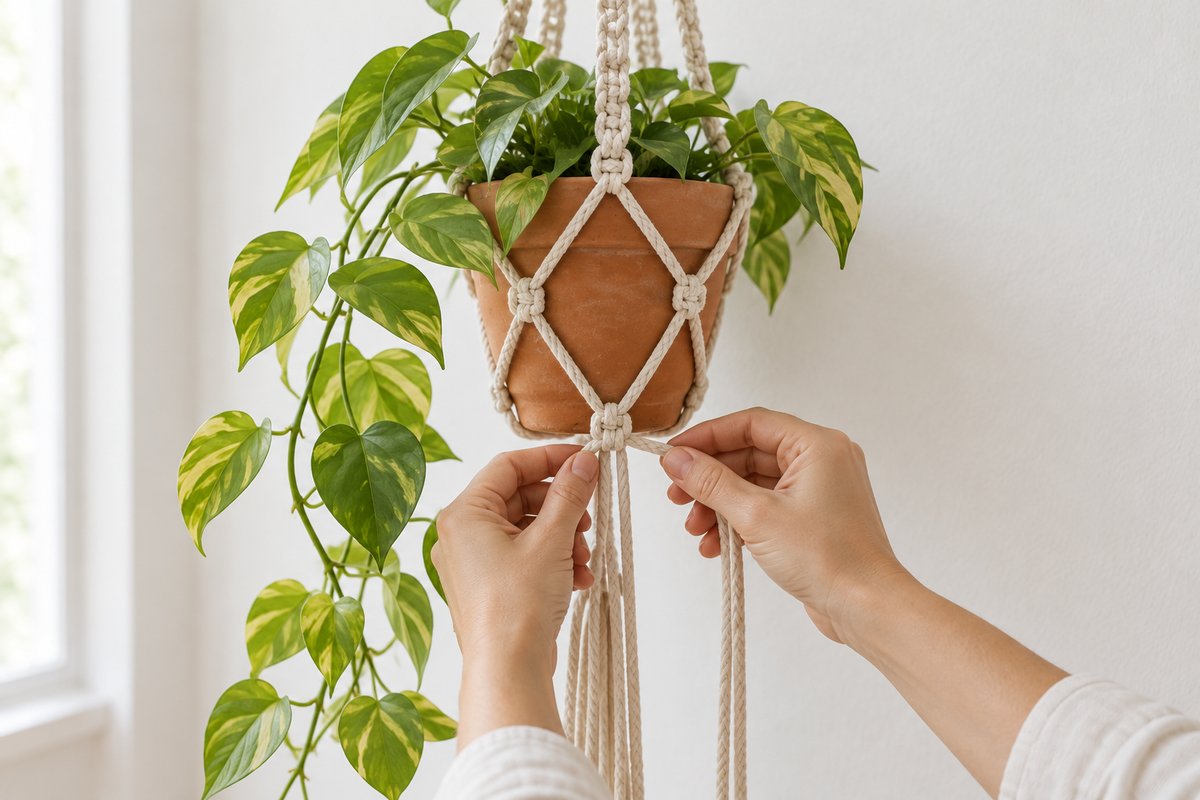
Step 8: Tie the bottom wrapping knot, trim and comb the tassel
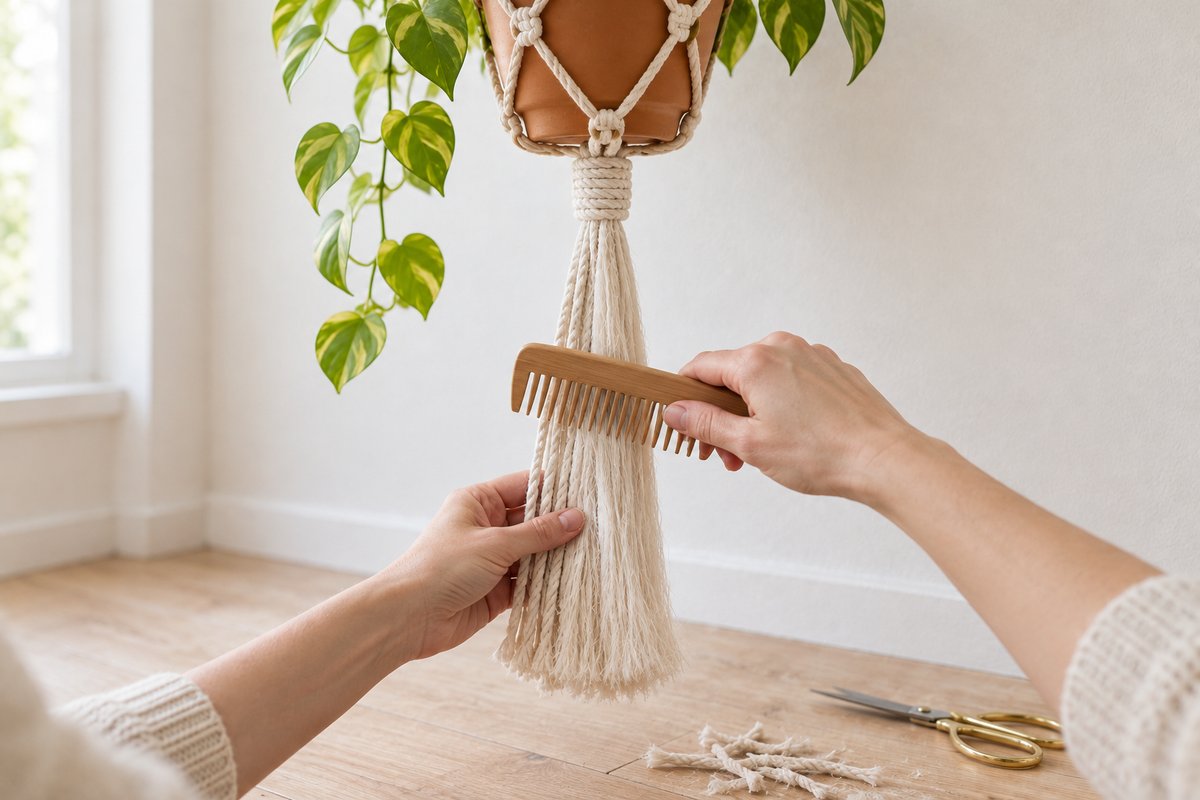
Gather all 16 cords directly under the center of the pot base, about 7.5 cm (3 in) below the last net row. Lift the pot out and tie a wrapping knot with the second 50 cm (20 in) piece exactly as in Step 3, wrapping 10 to 12 times. Measure 25 cm (10 in) below the wrapping knot and trim the cords straight across. Untwist each cord with your fingers, comb from the ends upward until soft, and trim again to a clean line. For a twisted fringe instead, tie a loose overhand knot 2 cm (0.75 in) from each end so it cannot unravel.
Tips for a better result
- Keep every knot at the same height. Count knots for the sinnets and use a card strip for the gaps; four sinnets of 12 knots will match, four of “about 6 inches” will not.
- Pull the working cords sideways, not downward. Pulling out to the sides tightens the knot around the fillers; pulling down slides it and leaves it loose.
- Know the weight limit. A 4 mm cotton hanger with four sinnets comfortably carries a 6 in (15 cm) terracotta pot with wet soil, about 2 to 3 kg (5 to 7 lb). Keep the total under 4.5 kg (10 lb); the ceiling hook and its anchor are usually the weakest link.
- Use a cachepot. Cotton stains from mineral-rich water; a nursery pot inside a cachepot keeps the cord dry.
Troubleshooting
The sinnet twists into a spiral instead of lying flat
Only the first half of the square knot is being repeated, which makes a half-knot spiral. Undo to where the spiral started and alternate the halves: left cord over, then right cord over.
The knots are different sizes or the sinnets are different lengths
Uneven tension. Snug each knot with the same sideways pull and push it against the knot above before starting the next. If one sinnet ends up 1 cm shorter, add a knot, or the basket will hang crooked.
The wrapping knot slides or unravels
The wraps were loose or too few, or the tail was not pulled hard enough to drag the bend under the wraps. Unpick it, wrap 8 to 10 times pulling each wrap tight, and tug the tail until the loop locks. A dab of fabric glue on the trimmed tails is a sensible backup.
The pot does not fit through the net
The rows are too close together. The gap should be about half the pot’s width: 7.5 cm (3 in) for a 6 in pot, 10 cm (4 in) for an 8 in pot. Undo the last row and retie it lower.
Variations
- Size it for a different pot. For a 4 in (10 cm) pot, cut the 8 cords at 3 m (10 ft) and space the net rows 5 cm (2 in) apart. For an 8 in (20 cm) pot, cut them at 5 m (16.5 ft), space the rows 10 cm (4 in) apart and add a fourth row. Over 10 in (25 cm), use 5 mm cord and 12 cords.
- Spiral sinnets. Tie only the first half of the square knot, over and over, for the top sections; the sinnet twists into a spiral on its own.
- Wooden beads. Slide a bead with a 10 mm hole onto the two filler cords above the first basket row, then tie the basket knot beneath it.
How to use, store and care for it
Hang the ring from a ceiling hook screwed into a joist, a curtain-rail bracket, or a wall hook that can take at least 4.5 kg (10 lb). Trailing plants such as pothos look best. Water the plant in the sink and let it drain for 10 minutes before returning it so the cord stays dry.
Hand wash the empty hanger in cool water with a teaspoon of mild detergent, squeezing rather than wringing. Rinse, roll it in a towel, then hang it from the ring with an empty pot in the basket so it dries straight. Cotton shrinks 2 to 3 percent in warm water and twists in a tumble dryer, so avoid both. As a gift, pair it with a small plant or a mason jar soy candle for a housewarming set.
Frequently asked questions
How much cord does a macramé plant hanger need?
For a 1 m (40 in) hanger holding a 6 in pot, 8 cords of 4 m (13 ft) plus 1 m for the wrapping knots, about 33 m (108 ft) in total. The rule is four times the finished length per folded cord, or five to six times for heavily knotted designs.
What is the difference between a left-facing and a right-facing square knot?
Only which working cord starts on top. A left-facing square knot begins with the left cord over the fillers; a right-facing knot starts with the right cord. Both are equally strong, so pick one and use it throughout.
How much weight can a 4 mm cotton hanger hold?
With four sinnets sharing the load, 4 mm cotton is comfortable with 4.5 kg (10 lb), which covers a 6 or 8 in pot with wet soil. The hook and its anchor are far more likely to fail than the cord, so fix the hook into a joist or use an anchor rated for the load.
Can the hanger be made without a ring?
Yes. Fold the 8 cords in half and tie a wrapping knot 5 cm (2 in) below the fold, leaving the folded loop to hang from. A plain loop is fine for pots up to 6 in.
Why do the sinnets twist as they are tied?
Because only half of the square knot is being repeated, and a column of half knots spirals. Every knot needs two halves: the first with the left cord over the fillers, the second with the right cord over.
Can the hanger go outdoors?
Under a covered porch, yes, for the warm months. Unprotected cotton greys in sunlight, mildews when damp and weakens over a season outdoors. For year-round outdoor use, choose polyester macramé cord, which does not absorb water.
More to make
The same cotton cord strings a dried orange slice garland and ties up a batch of beeswax wraps or a jar of homemade sugar scrub as a gift. For a shelf under the hanger, DIY mason jar soy candles and salt dough ornaments carry the same natural palette. For more handwork, the how to crochet guides start from the very first stitch.